
Warehouse workers on demand · Toronto & GTA
Warehouse temps for Toronto and the GTA
Containers back up at the dock, a large order drops at 4 p.m., or holiday volume lands a week early: the floor needs people today. Aukazi sends vetted pickers, packers and loaders to warehouses across Toronto and the GTA, booked shift by shift. Further down: the Ontario rules for temps who work on foot where lift trucks run, and what to agree on before their first shift.
- Licensed in Ontario: THA-0000008100
- 98% of shifts filled within 24 hours
- Vetted before the first shift, rated after every one
Roles in the aisles
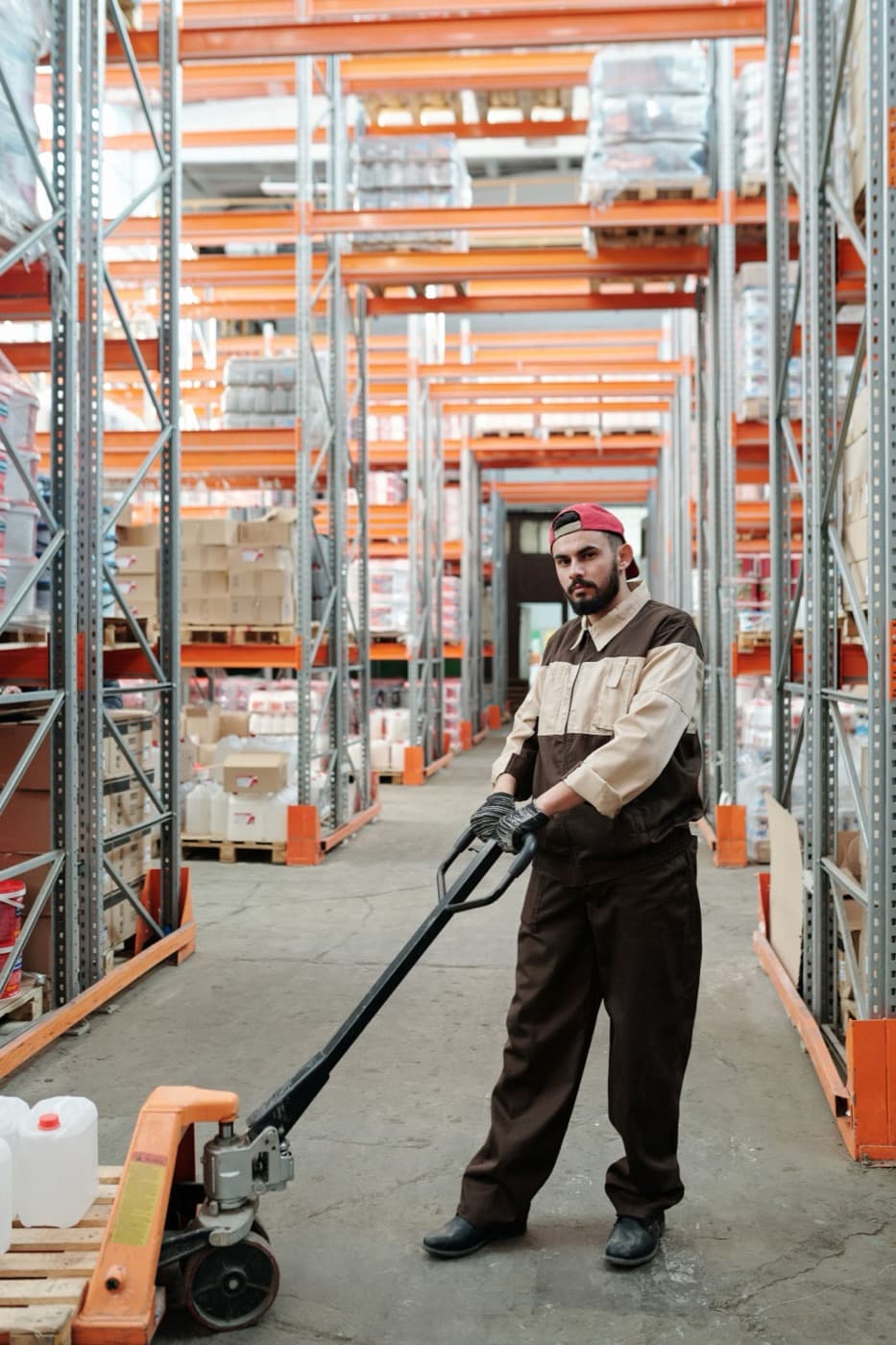
Floor roles we book for GTA warehouses and distribution centres, one shift or a whole season at a time. All of them are done on foot.
- Order pickingPulling units or cases to a pick list or a scanner, aisle by aisle.
- PackingBuilding cartons, packing orders, labelling and staging them for the carrier.
- Container unloading and loadingFloor-loaded containers and trailers emptied by hand, or outbound pallets loaded.
- Triage and returnsSorting inbound goods and customer returns into stock, rework or disposal.
- General labourReplenishing pick faces, wrapping pallets, cleaning up the dock between runs.
- DeliveryLast-mile runs for sites that ship directly to customers.
Also running a warehouse in Québec? Our Montréal warehouse page covers how shifts work there.
Temps on foot, trucks on the floor
Ontario's rules where temps walk and lift trucks run
Most agency temps in a GTA warehouse never drive anything, yet they spend the shift in aisles and at docks where powered lift trucks work. Ontario's Industrial Establishments regulation (Reg. 851) sets the floor rules. Each row: the rule, what the host site does, and what to settle with the agency before the first shift.
| Rule | What your site does | Settle before the first shift |
|---|---|---|
| Stock stored so it cannot tip, collapse or fall, and can be pulled out without dangerReg. 851, ss. 45 and 46 [1] | What your site doesKeeps racking and stacks in that state before temps pick from them, and secures equipment or material that could tip. | Settle before the first shiftWhich aisles, racks and stack heights temps will work at. |
| A signaller whenever the driver cannot see the path or the loadReg. 851, s. 56 [1][4] | What your site doesUses a competent signaller who stands in the driver's view, sees the whole path and stays clear of it. The ministry's guideline adds a code of signals that the signaller has learned. | Settle before the first shiftWhether a temp will ever guide a truck. If yes, who teaches them your signals. If no, write it in the shift notes. |
| No load passes over a worker, no truck carries more than its rated load, and controls stay attended while a load is raisedReg. 851, ss. 51(2)(b) and 59 [1][2] | What your site doesKeeps load ratings visible on each truck and sets rules for anyone on foot near raised forks. | Settle before the first shiftWhere temps must never stand: under a raised load, or between a moving truck and the racking. |
| A truck left unattended is immobilized, with its forks lowered or solidly supportedReg. 851, ss. 57 and 58 [1][2] | What your site doesEnforces parking rules in picking and staging areas. | Settle before the first shiftWhere trucks park and charge, so temps don't stage pallets in those spots. |
| People on foot protected from collisionsMinistry lift-truck guideline, safety program [4] | What your site doesPuts up barriers, warning signs, designated walkways or other safeguards where pedestrians could be hit, and tells everyone who works near trucks about the hazards and the written rules. | Settle before the first shiftA walkway map in the shift instructions, or a five-minute walk-through when the shift starts. |
| Lift trucks operated only by a competent person, or by a worker being instructed with a competent person alongsideReg. 851, ss. 51(2)(a), 54(1)(d) and 54(2) [1][3] | What your site doesDecides who is competent on its own trucks. | Settle before the first shiftTemps booked through Aukazi stay on foot: they do not drive lift trucks. |
- Two employers, one floor. Under the Occupational Health and Safety Act, an employer includes a person who contracts for a worker's services, and the province says health and safety duties apply to both the agency and the host. Your site's hazards are yours to explain; the agency sends people ready to listen. [5][6]
- The guideline reads "lifting device" in section 51 as the whole truck, not just the mast, and points to sections 52, 54 and 56 to 59 as applying to lift trucks as well. [2]
- Hazard information is owed to the people who walk near trucks, not only to drivers. Section 25(2)(d) of the Act requires an employer to acquaint a worker with any hazard in the work; the guideline turns that into a written hazard report shared with the floor and reviewed when the work changes. [4][5]
- A wallet card says someone took a course somewhere. The guideline asks the employer to see the skills on the truck that will be used, in the conditions of its own site, and to keep a record of who was assessed. [3]
If a temp would ever drive a lift truck
- Who decides
Competence is the employer's to establish
Section 51 lets only a competent person, or a worker under instruction who is accompanied by one, operate a lifting device. The ministry's guideline makes establishing that competence the employer's responsibility, through training or in some other way. [1][3]
- On your truck
Skills shown on the truck to be used
The guideline lists what an operator should demonstrate to someone with expert knowledge: the pre-operational check, start-up and shut-down, driving and parking around people, picking up and placing loads, and loading trailers. It asks for this with the truck they will run, under typical conditions at your site. [3]
- On file
A record for each operator
For each worker: the skills and knowledge shown, the class of truck, the assessor's name and affiliation, and the date. The guideline says an employer may also issue certificates to help identify competent operators. [3]
Summary of R.R.O. 1990, Reg. 851, ss. 45, 46, 51, 54 and 56 to 59 (e-Laws, current to 19 November 2026) and the ministry's Guideline for the safe operation and maintenance of powered lift trucks (updated 7 March 2023), checked November 2026. Aukazi books pickers, packers and loaders who work on foot; it does not supply or assess lift-truck operators. General information, not legal advice.
Where GTA warehouse shifts happen
The region's freight runs on a handful of highways, two rail terminals and one airport. Where your dock sits decides when crews are needed and how they get there.
The 401 through Toronto
Between the 427 and the 404, Ontario's transportation plan puts traffic at its busiest point above 416,000 vehicles a day, including 41,000 trucks. Inbound loads arrive when the road lets them: book unloaders for the window your dock actually sees, not the one on the appointment sheet. [8]
More: Staffing in TorontoCN's Brampton intermodal terminal
CN lists its Brampton terminal on Intermodal Drive as open 24 hours, so containers reach Peel warehouses at any hour. Tell us when the box lands and we book the unloading crew for that time. [9]
More: Staffing in BramptonCPKC Vaughan, at Highway 50 and Rutherford
Peel Region's goods movement plan counts about 2,000 truck trips a weekday at the Vaughan intermodal facility. Cross-dock and transload work around it moves with the rail schedule, not office hours. [10]
More: Staffing in VaughanAround Toronto Pearson
The airport handles about 45% of Canada's air cargo. Forwarders' warehouses near it need pickers, packers and loaders on the ground side; airside roles are not ones Aukazi books. [11]
More: Staffing in Mississauga
Booking for the peak
If your volume climbs from November into the holidays and falls back in January, staff the curve rather than the year.
- Add people as orders climbScale crews up and down in near real time, with no long-term contract to sign.
- See who showed upYour supervisors follow live attendance in the Supervisors App, ask for a backup when someone doesn't come and score each worker after the shift.
- Know the crew before it arrivesBefore each shift you see confirmed coverage and which workers already know your site. We help with onboarding and training for your floor.
98% of shifts filled within 24 hours
3,000+ shifts filled every month
100+ locations served across Canada
90% worker retention
Ask for the licence number
Ontario has required temporary help agencies to hold a licence since 1 July 2024, and a client who knowingly uses an unlicensed agency is in breach too. Look any agency up in the province's public record before you book it. [7]
Aukazi's Ontario licence, held by Les Entreprises Aukazi Inc.: THA-0000008100
What the record shows, step by stepOpen Ontario's public licence record
When another firm is the better call
If you need lift-truck or reach-truck operators, use an industrial agency that assesses operators, or train and assess your own: Aukazi does not book that role. A site that wants an agency coordinator on its floor every day is better served by a large chain with GTA branches. And an inventory controller or shift lead you plan to keep is a hire, not a shift.
Questions employers ask
Does Aukazi supply warehouse workers in Toronto and the GTA?
Can a temp drive our forklift if they have a forklift certificate?
Who is responsible for an agency worker's safety in our warehouse?
How quickly can you staff a warehouse shift?
More for employers
Ontario
- Staffing in TorontoUsing a temp agency in Ontario: the licence check and what the ESA asks of you.
- Staffing in MississaugaOntario's shift rules as booking decisions: the three-hour rule, overtime, rest and holidays.
- Staffing in BramptonEnding a long assignment early: Ontario's notice rule for agency workers.
- Staffing in VaughanHiring a temp permanently: the six-month fee window in Ontario.
- Staffing in MarkhamThe first shift on your floor: who covers which safety duty.
- Staffing in Oakville and HaltonPublic holidays with agency workers: how the pay adds up.
- Staffing in HamiltonA temp's first hot shift: what Ontario expects in the heat.
- Staffing in Oshawa and DurhamWhat to send with a shift request, from what the agency must tell workers.
- Staffing in OttawaJob postings in Ontario since January 2026: what the ad has to say.
- Manufacturing staffing in OntarioSick, family, bereavement and long-term illness leave: the absences Ontario law lets your crew take.
- Staffing in Kitchener-WaterlooElectronic monitoring of agency workers: the policy Ontario expects.
Québec
- Warehouse staffing in MontréalHow a warehouse shift runs on Aukazi, from booking to hours worked.
- 3PL, logistics and last-mile staffingA peak-season plan: what to book, and when.
- Manufacturing & light industrial staffingBefore the first shift on your floor: who does what under Québec law.
- Retail & seasonal staffingQuébec's 2026–27 holiday store hours, and what to book around them.
- General labour staffingQuébec's short-shift rules: the 3-hour minimum, meal breaks and overtime limits.
- Staffing in MontréalHiring temps in Québec: the CNESST permit and what the law expects from you.
Western Canada
- Staffing in Vancouver, Richmond and DeltaBC's Pay Transparency Act: pay in every job ad, no pay-history questions.
- Staffing in BurnabyBooking agency shifts under BC's rules: daily overtime, sick days, holidays.
- Staffing in Surrey and the Fraser ValleyWorkSafeBC clearance letters: checking a firm before and after the work.
- Staffing in CalgaryAlberta's shift rules: the 12-hour window, overtime, breaks and short shifts.
- Staffing in EdmontonSafety and WCB with agency workers in Alberta, duty by duty.
- Staffing in Saskatoon and ReginaSaskatchewan's scheduling rules: a week's notice, call-in pay, rest.
- Staffing in WinnipegManitoba's eight-month rule for hiring an agency worker permanently.
All provinces
Sources
- R.R.O. 1990, Reg. 851, Industrial Establishments, ss. 45, 46, 51, 54, 56 to 59 (e-Laws, current to 19 November 2026)
- Ontario, Guideline for the safe operation and maintenance of powered lift trucks: legal requirements (updated 7 March 2023)
- Ontario, Guideline for the safe operation and maintenance of powered lift trucks: competency (updated 7 March 2023)
- Ontario, Guideline for the safe operation and maintenance of powered lift trucks: safety program (updated 7 March 2023)
- Occupational Health and Safety Act, ss. 1 and 25 (e-Laws)
- Ontario: temporary help workers, agencies and host employers (updated 5 July 2022)
- Ontario: licensing for temporary help agencies and recruiters (updated 4 March 2026)
- Ontario Ministry of Transportation: Greater Golden Horseshoe transportation plan (March 2022)
- CN: intermodal terminals, Brampton
- Region of Peel: Goods Movement Long Term Plan (2019), pp. 71–72
- Greater Toronto Airports Authority: Toronto Pearson fast facts
Lift-truck and floor rules checked November 2026 on ontario.ca and in Regulation 851 on e-Laws. General information, not legal advice.
Tell us what you need
Temp workers, a recruitment search or a software demo: we reply within 24 hours, with no obligation.
- Phone
- (438) 288-1004
- Toll-free
- (844) 4AU-KAZI
- info@aukazi.com
- Office
- Montréal, Québec
Rather talk first? Book a call